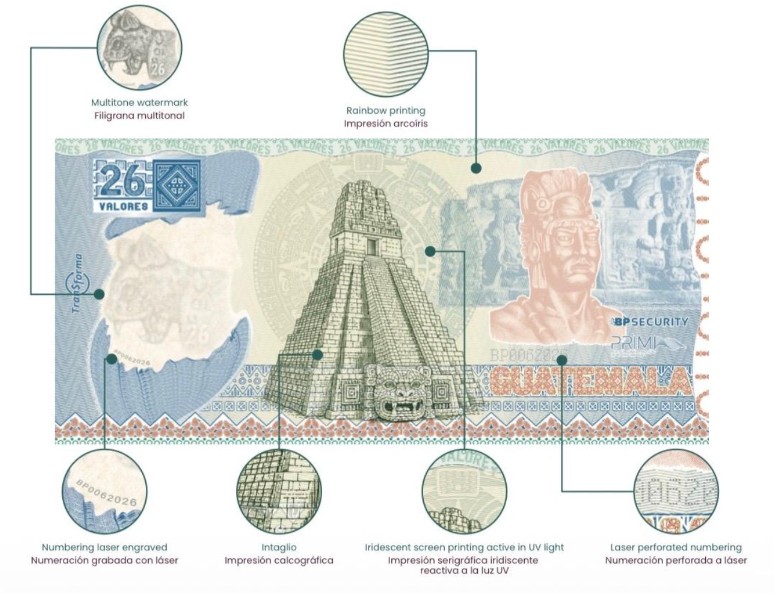
Sustainable Banknote Produced by Primi and BlendPaper Featured at High Security Printing (HSP)
International security printing event brought together the leading companies in the industry in Guatemala.
An innovative sustainable banknote, developed from recycled cotton fibers recovered from banknote paper waste, was one of the highlights of High Security Printing (HSP) Latin America, held from the 1st to the 3rd of this month in Guatemala City, Guatemala. Produced by the Brazilian companies Primi and BlendPaper, the banknote combines traditional high-security features—such as multicolor Intaglio printing, numismatic backgrounds, security guilloches, microprinting, invisible backgrounds, and ornamental frames—with cutting-edge technologies, including microperforated numbering and laser marking.
In addition to its sustainable composition, the banknote incorporates UltraLife Fusion™, an advanced technology that significantly enhances its durability. The system combines increased internal fiber cohesion with the application of an external protective coating, resulting in superior mechanical resistance, improved circulation performance, and preservation of the distinctive tactile feel of cotton-based banknote paper. The integration of these attributes creates a substrate that combines sustainability, security, and longevity, meeting the growing demands of central banks and the global security printing industry.
During the event, the Brazilian companies also introduced a new solution for the production of security labels and seals designed for a wide range of industrial sectors. The technology features an advanced traceability system capable of monitoring and ensuring product integrity from manufacturing through to the end consumer. By generating detailed reports and strategic information, the tool effectively contributes to fraud prevention and anti-counterfeiting efforts.
The sustainable substrate used in the banknote was developed by BlendPaper and reinforces the principles of the circular economy applied to the security sector. “Our innovative proposal was one of the highlights of the event, demonstrating that Brazil has cutting-edge technology and the capability to develop highly competitive solutions for the industry,” explains Victoria Ferreira, Project and Development Coordinator at Primi.
About Primi
With more than 30 years in the market, Primi is a national reference in high-security printing. The company is a seven-time winner of the Fernando Pini Graphic Excellence Award, promoted by leading institutions in the Brazilian printing industry, including SENAI, ABIGRAF, and ABTG.
Primi holds nationally and internationally recognized certifications, including ISO 9001 (Quality Management), ISO 14001 (Environmental Management), ISO 27001 (Information Security Management), ISO 45001 (Occupational Health and Safety Management), ISO 14298 (Security Printing Process Management System), and NBR 15540 (Security Management in Graphic Processes), reinforcing its commitment to excellence, innovation, sustainability, and security.